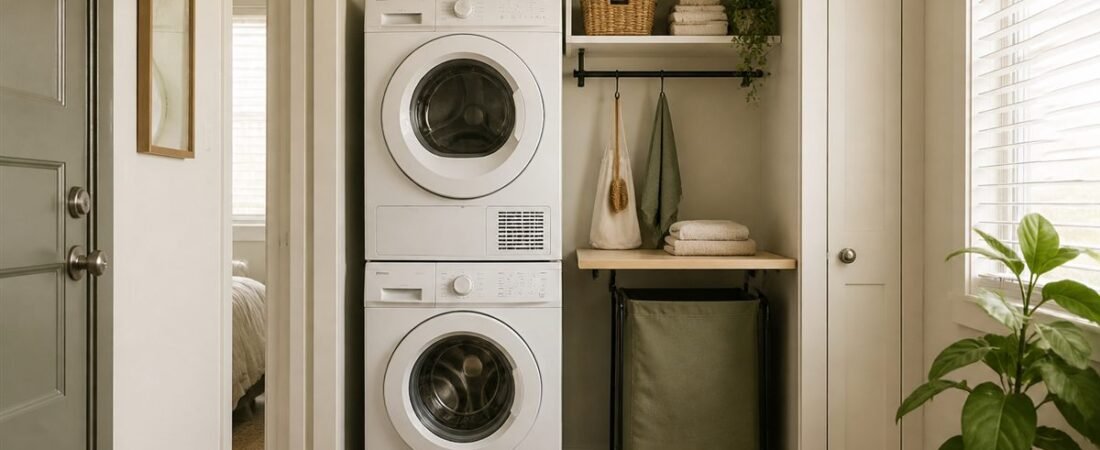
A small laundry area can become cluttered faster than almost any other part of a home. Detergent lands on top of the dryer, clean clothes wait in a basket, and the few inches beside the machines collect items with no clear home. The best small laundry room ideas do not try to fill every wall. They create a short, repeatable path for sorting, washing, drying, folding, and putting things away.
This renter-friendly guide focuses on storage solutions that work in laundry closets, narrow utility rooms, apartment bathrooms, and kitchen laundry corners. Start with the ideas that solve your biggest bottleneck, measure before buying, and keep appliance access and ventilation more important than extra storage.
Quick answer: how do you organize a very small laundry room?
Use the wall above or beside the machines, keep one small sorting system, and give daily supplies a single easy-to-reach zone. A shelf or closed cabinet can hold detergent, a slim cart can use a narrow side gap, and a tension rod or fold-down rack can add temporary drying space. Leave the floor and appliance access points clear, and move bulk backstock somewhere else.
If you only make four changes, start here:
- Measure the machines and every usable gap. Include doors, hoses, vents, baseboards, and the path needed to service the appliances.
- Create one laundry-supply zone. Keep the products used every week together instead of spreading them across several shelves.
- Add one vertical storage solution. Choose a shelf, cabinet, hooks, or a hanging rail based on what you actually need to store.
- Protect one folding or sorting surface. This may be a removable counter, the top of a front-loading machine when permitted, or a fold-down shelf.
Before adding storage, measure the entire laundry zone
A product can fit the empty gap and still prevent a washer door from opening, pinch a hose, block a vent, or make the machine difficult to service. Measure the space as a working zone rather than a rectangle.
Record these dimensions
- the width, depth, and height of the room or closet;
- the appliance width and depth, including knobs, doors, hoses, and vent connections;
- the full swing of each appliance and closet door;
- the narrowest point beside the machines, measured at the floor, middle, and top;
- the height you can reach safely without leaning over an appliance;
- the space required by the appliance manufacturer for ventilation, installation, and service.
Take photos of the water shutoff, drain, outlet, dryer vent, and lint-filter access. Storage should never make those points harder to reach. If you rent, check your lease before drilling, adding heavy wall storage, or changing appliance connections.
17 renter-friendly small laundry room ideas
1. Use the wall above the machines
The wall above a washer and dryer is usually the largest unused area in a compact laundry room. One properly installed shelf can hold baskets, spare towels, and light supplies. Closed cabinets reduce visual clutter, while an open shelf makes frequently used items easier to see.
Do not guess at height. Check how far appliance lids and doors open, how high you can reach comfortably, and where plumbing or electrical lines may run. Heavy containers should not be stored where they must be lifted over your head.
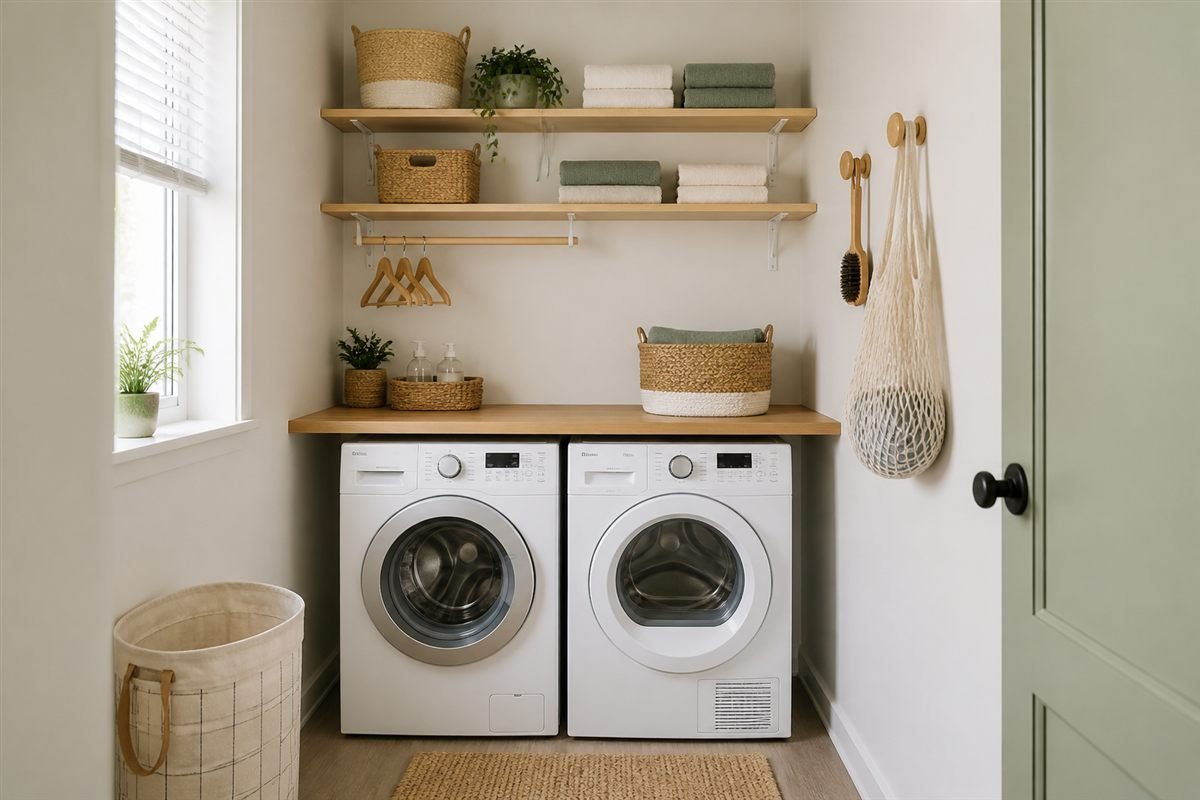
2. Add a removable counter above front-loading machines
A shallow removable counter can create a stable folding surface above side-by-side front-loading machines. It also prevents small objects from falling into the gap between them. The counter must not interfere with controls, ventilation, machine movement, or the manufacturer’s installation requirements.
In a rental, a freestanding or removable design is usually more practical than a wall-to-wall built-in. Add nonslip pads only when they are compatible with the appliance finish, and remove the surface easily when service is needed.
3. Use a slim rolling cart in a true dead gap
A narrow cart can store clothespins, dryer balls, cleaning cloths, and sealed supplies beside the machines. Measure the gap at several heights because walls, trim, and appliances are not always perfectly square. Choose a cart that rolls out fully without scraping hoses or blocking an appliance door.
Keep the cart edited. A narrow cart becomes difficult to use when every level is packed with unrelated bottles. Give each shelf one broad purpose and keep the heaviest items low.
4. Choose a vertical hamper instead of several floor baskets
A divided upright hamper can sort light, dark, and delicate loads in the footprint of one basket. Another option is a single slim hamper plus two reusable sorting bags stored on hooks. The best system is the one that matches how often you wash, not the one with the most compartments.
Measure the hamper with its lid open and confirm that full bags can be removed without moving the appliance or blocking the walkway.
5. Install temporary hanging space
A tension rod, removable garment bar, or fold-down drying rack can hold shirts straight from the washer and give delicate items a place to air-dry. Position it where damp clothing will not touch controls, electrical outlets, or the top of a hot appliance.
Use the lightest solution that meets your needs and follow its weight limit. A rod that holds a few shirts does not need to become permanent storage for an entire wardrobe.
6. Use the back of the door carefully
An over-the-door organizer can hold stain brushes, mesh bags, clothespins, and other light accessories. First check door thickness, top clearance, hinge strength, and whether the organizer will strike shelves or machines when the door closes.
Avoid loading the door with heavy detergent containers. Added weight can strain hinges, and liquids may fall when the door moves.
7. Combine one open shelf with closed containers
Open storage is useful for items you reach for every wash. Closed or lightly opaque containers are better for mismatched backstock and rarely used supplies. Combining the two keeps the room functional without letting every package become part of the decor.
If you are deciding which items should remain visible, compare the practical tradeoffs in our guide to open shelving versus closed storage.
8. Add hooks for repeat-use tools
Hooks can organize a lint brush, reusable mesh bags, a small dustpan, an empty laundry tote, or hangers waiting to be used. Place them on an appropriate wall, inside a cabinet door, or on a removable rail where they will not snag clothing or narrow the walkway.
Assign hooks only to items used regularly. A wall covered with hooks can become another clutter surface if every bag and cleaning tool is allowed to stay.
9. Use a fold-down surface when floor space is tight
A fold-down shelf can provide temporary space for sorting or folding and disappear when the task is finished. It is especially helpful in a narrow laundry room where a permanent cabinet would interfere with movement.
Wall-mounted versions require suitable anchors and landlord approval. A compact folding table stored nearby may be the safer renter-friendly alternative when the wall construction is unknown.
10. Create a small stain-treatment station
Keep a stain brush, white cloth, and the one or two treatment products you actually use in a shallow tray or bin. The station should be easy for an adult to reach but secured from children and pets. Follow each product label rather than mixing cleaners or transferring them into unmarked containers.
A contained station prevents half-used products from spreading across the washer and makes it easier to wipe up drips.
11. Limit laundry backstock
Bulk detergent and large packages can erase the benefits of a well-organized small laundry room. Give unopened supplies one fixed shelf or bin. When it is full, use what you have before buying more.
Keep the active product near the machines and move true backstock to a dry, secure cabinet elsewhere when the laundry area cannot hold it safely. This follows the same capacity-limit principle used in our guide to organizing a small kitchen without a pantry.
12. Store detergent with safety before convenience
Detergent should remain in its original labeled container. In homes with children or vulnerable adults, liquid laundry packets and other concentrated products need locked storage that is out of sight and reach. A high open basket is not the same as a locked cabinet.
The U.S. Consumer Product Safety Commission’s laundry-packet guidance specifically recommends keeping packets sealed in their original packaging and locked away from children.
13. Keep appliance access clear
Do not place permanent bins in front of the water shutoff, drain, electrical outlet, lint filter, dryer vent, or access panels. A narrow room needs a clear maintenance plan as much as it needs storage.
Take one photo of the empty utility connections and keep the appliance manuals. If a leak, unusual vibration, or drying problem develops, you should be able to reach the relevant connection without dismantling the entire room.
14. Reduce visual clutter with repeated containers
You do not need matching containers for everything. Repeating one basket style on an open shelf is enough to make the room feel calmer. Use broad categories such as “drying,” “cleaning cloths,” and “backstock” rather than a separate bin for every small item.
Leave a little open space. A shelf that is completely full is harder to clean and gives new supplies nowhere to go.
15. Label the routine, not the brand
Labels work best when they describe a stable function. “Stain care” survives a change in product; a label naming one bottle does not. Keep labels short and readable from the normal standing position.
In a shared home, add a simple “wash next” basket or hook so clothing that needs special handling does not disappear into the main hamper.
16. Borrow one nearby storage zone
A laundry closet does not need to store every cleaning product, spare towel, vacuum attachment, and household tool. Move rarely used items to one nearby closet shelf or closed utility bin. Keeping a single overflow zone is easier to manage than scattering supplies around the home.
For more ways to distribute storage without losing track of belongings, see these small-apartment storage ideas that make every inch count.
17. Reset the room for ten minutes each week
Return empty hangers, remove lint, put away clean clothing, wipe the folding surface, and check whether any supply is almost finished. A short weekly reset prevents the room from becoming a waiting area for every unfinished laundry task.
Link this reset to the day you already wash the final load of the week. For a whole-home version, use our simple weekly reset routine for a small apartment.
Three layouts for common small laundry spaces
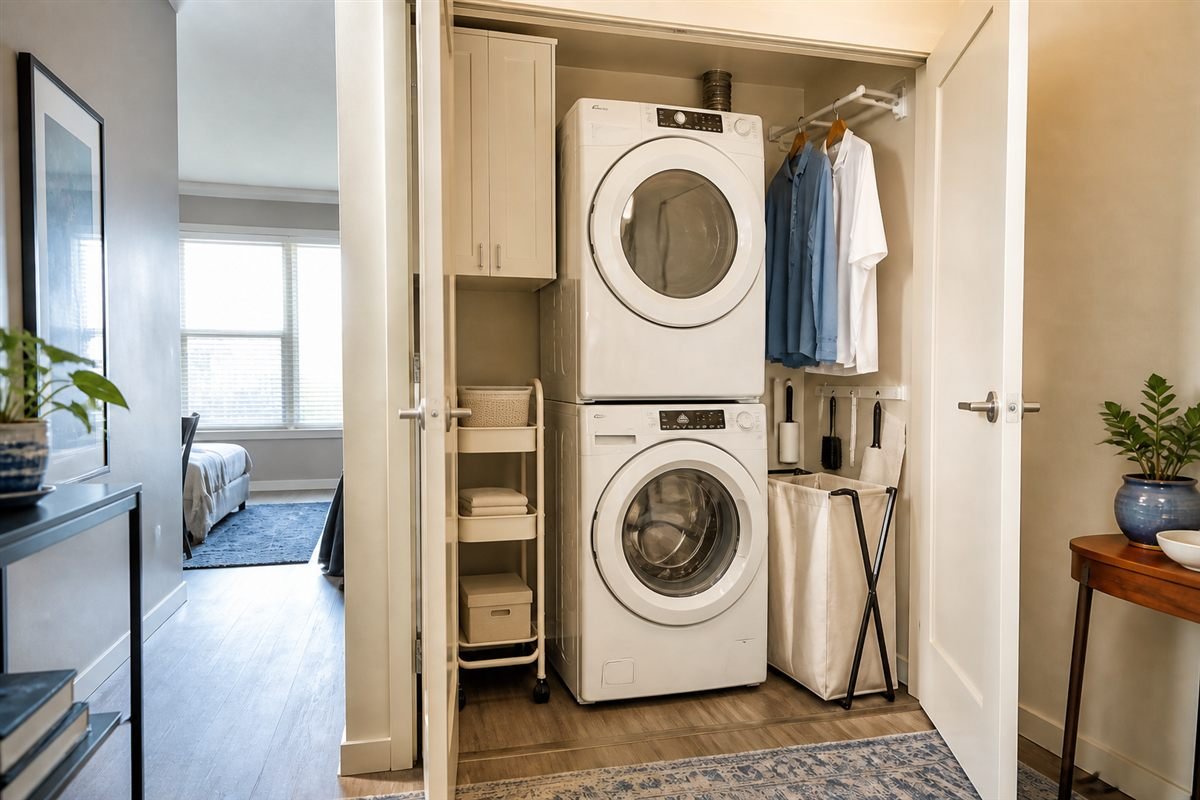
For a laundry closet
- Use stacked machines only when the appliances and stacking kit are designed for that configuration.
- Keep one narrow cart or vertical hamper beside the machines if the measured gap permits it.
- Add a tension rod or short removable rail for a few air-dry items.
- Use the closed upper cabinet for products that need secure storage.
- Keep closet doors and appliance doors able to open fully.
For a narrow walk-in laundry room
- Place shallow storage on only one side to protect the walkway.
- Use a fold-down surface instead of a permanent table.
- Keep the far end visually simple so the room does not feel crowded.
- Store the hamper near the entrance only if it does not interfere with the door.
For laundry inside a bathroom or kitchen
- Keep laundry products physically separate from food, toiletries, and medicines.
- Use closed storage to reduce visual clutter in the shared room.
- Choose a hamper with airflow that fits beneath a counter or inside a nearby closet.
- Never cover appliance vents or treat the machine top as unlimited storage.
If the surrounding room feels crowded, these renter-friendly ways to make a small room look bigger can help simplify the visual layout.
Optional organizers worth considering
You do not need all of these products. Choose the item that solves a measured problem, confirm the current dimensions, and check whether installation is appropriate for your lease and wall type.
Best for air-drying in a small footprint: a wall-mounted drying rack
A folding drying rack can disappear against the wall when it is not in use. Compare the open depth, mounting method, weight limit, and number of rails. If drilling is not permitted, look for a freestanding or over-the-door alternative.
Browse wall-mounted folding drying racks on Amazon
Best for a narrow side gap: a slim rolling laundry cart
A cart is useful only when it can roll out completely and remain clear of hoses, vents, and appliance doors. Measure the gap at several heights and compare the cart’s assembled dimensions rather than relying on the product name.
Browse slim rolling laundry carts on Amazon
Best for sorting without several baskets: a narrow divided hamper
Look for removable washable bags, a stable frame, comfortable handles, and a lid that can open in the available space. Two sections are often easier to maintain than three or four very small compartments.
Browse slim divided laundry hampers on Amazon
As an Amazon Associate I earn from qualifying purchases. Product availability, prices, dimensions, and seller details may change. Check the current listing before ordering.
What is usually not worth buying for a tiny laundry room
- Deep shelving that narrows the walkway. More capacity does not help if you cannot open an appliance door comfortably.
- Large decanted detergent dispensers. They can leak, hide product instructions, and create a safety concern when the original labeled container is discarded.
- Permanent storage before measuring service access. Appliances, hoses, valves, and vents eventually need attention.
- Too many sorting compartments. Empty sections consume floor space and make small loads wait longer.
- Heavy door organizers. They can strain hinges and swing bottles toward the floor.
- Decorative signs and containers that replace useful space. In a tiny utility area, every permanent object should support the routine.
Laundry room safety and maintenance
- Plug washers and dryers directly into appropriate wall outlets rather than extension cords.
- Clean the lint filter before or after each dryer cycle and keep the vent path free from crushing or obstruction.
- Do not store paper, textiles, or other combustible items behind a dryer.
- Keep water shutoffs, drains, outlets, vents, and access panels reachable.
- Follow the appliance manual for installation clearances, stacking kits, countertop use, and ventilation.
- Keep detergent and stain products in their original containers and secure them from children and pets.
- Stop using an appliance with a damaged cord, unusual heat, burning smell, leak, or persistent abnormal vibration until it is evaluated.
The U.S. Fire Administration’s appliance and electrical fire guidance advises plugging major appliances directly into wall outlets and identifies failure to clean as a leading factor in home dryer fires. Its clothes dryer fire-safety guide also recommends cleaning lint filters and checking that dryer venting is not damaged, crushed, or restricted.
Frequently asked questions
How can I organize a laundry room with no cabinets?
Use one shallow shelf for light daily items, a narrow cart for accessories, and a tension rod or removable hooks for air-dry clothing. Store chemicals in a secure cabinet elsewhere if the laundry area cannot provide safe closed storage.
Can I put a shelf directly above a washer and dryer?
Often yes, but the correct height and depth depend on the appliance doors, controls, ventilation, connections, and manufacturer requirements. Keep the shelf reachable and avoid placing heavy containers above head height.
What should stay on top of the dryer?
Ideally, very little. A removable folding surface may be appropriate for some front-loading machines when it does not block controls or ventilation. Do not treat the dryer top as permanent storage, especially for liquids, loose paper, or items sensitive to heat.
How do I hide laundry supplies in a small space?
Use one closed cabinet or a small number of opaque bins. Keep product labels and original packaging intact, and never place a cosmetic container system ahead of child safety, leak control, or clear identification.
Where should dirty clothes go in a tiny apartment?
Choose one ventilated hamper close to where clothes are removed or washed. A slim divided hamper can sort two categories, while reusable bags on hooks can handle delicate items without adding another basket.
Can I store cleaning supplies beside the washer?
Yes when the area is dry, the products stay in original containers, and they can be secured from children and pets. Keep them away from heat, food, and anything that may be damaged by a leak.
How do I make a laundry closet look less cluttered?
Limit open storage to light items used every week, repeat one or two container styles, leave part of each shelf empty, and move bulk backstock elsewhere. Closed doors or a curtain can hide the machines only when ventilation and appliance instructions permit it.
What is the easiest weekly laundry room reset?
Put away clean clothes, return hangers, clear the folding surface, empty the lint filter, wipe one shelf, and add nearly finished supplies to the shopping list. Stop after ten minutes so the routine remains realistic.
Small laundry room checklist
- Measure the room, machines, door swings, hoses, vents, and side gaps.
- Choose one easy-to-reach zone for active supplies.
- Keep detergent in original containers and secure it when needed.
- Add only one vertical storage solution at first.
- Protect appliance access and the walking path.
- Choose one sorting method that matches your wash routine.
- Create temporary hanging or folding space.
- Move bulk backstock to one nearby closed zone.
- Clean the lint filter and keep venting unobstructed.
- Reset the room for ten minutes each week.
Sources and further reading
- U.S. Fire Administration: Appliance and Electrical Fire Safety
- U.S. Fire Administration: Clothes Dryer Fire Safety
- U.S. Consumer Product Safety Commission: Single-Load Liquid Laundry Packets
The bottom line
The most effective small laundry room ideas protect the wash routine instead of simply adding more containers. Start with clear appliance access, one supply zone, one sorting system, and a temporary place to hang or fold clothing. Then add a shelf, cart, hamper, or closed cabinet only when it solves a measured problem.
A compact laundry area does not need to hold every household supply. It needs to make the next load easier, keep essential products secure, and return to order in a few minutes.