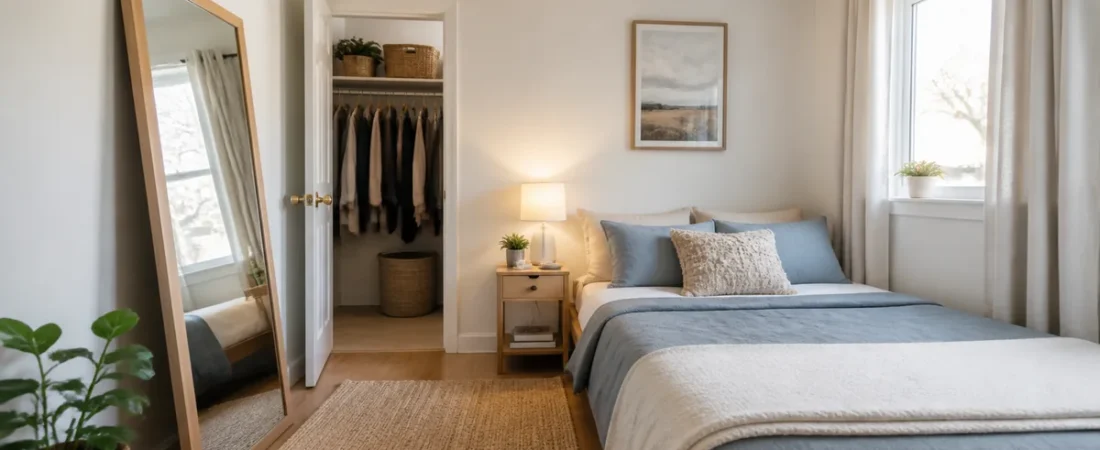
A small room does not need to feel cramped. The most effective visual improvements come from clearer sightlines, better light, and furniture that matches the scale of the space. Renters can create all three without painting, drilling many holes, or making permanent changes.
Before buying anything, remove items that do not need to live in the room and measure the largest pieces. A room often feels smaller because circulation is blocked, not because it lacks decorative objects.
Three renter-friendly visual upgrades
| Product | Visual effect | Best placement | Consider |
|---|---|---|---|
| MIULEE sheer curtains | Softens and spreads daylight | Mounted high and wide | Sheers do not provide blackout |
| KOMCOTE full-length mirror | Reflects light and sight lines | Opposite or beside a window | Avoid reflecting clutter |
| Slim floor lamp | Adds a second light height | Dark corner or bedside | Bulb is sold separately |
1. Keep the main walkway clear
Choose one natural route through the room and protect it. Move baskets, side tables, floor lamps, and plant stands out of that path. A clear walkway lets the eye travel farther and makes the room easier to use.
2. Hang curtains higher and wider
Place a tension rod or renter-friendly curtain hardware close to the ceiling and extend the fabric beyond the window frame. This exposes more glass when the curtains are open and makes the window appear larger. Use panels that reach the floor without pooling heavily.

MIULEE White Sheer Curtains, 54 × 84 Inches
Best for: softening daylight while keeping the room visually light
Advantages: two airy voile panels in a tall 84-inch length.
Consider: sheer fabric provides limited privacy and no blackout.
As an Amazon Associate I earn from qualifying purchases. Price, availability, and product details may change.
3. Use one large mirror strategically
A mirror can bounce daylight deeper into a room, especially when positioned across from or beside a window. One substantial mirror usually looks calmer than several small ones. Lean it securely or use mounting hardware rated for its weight and your wall type.
4. Choose furniture with visible legs
Sofas, chairs, nightstands, and consoles raised from the floor reveal more continuous flooring. That visual continuity creates a lighter impression. It also makes cleaning easier, provided the gap is high enough for your vacuum.
5. Match storage to the wall color
When a bookcase, cabinet, or removable shelving unit is close in color to the wall, its outline becomes less dominant. Renters who cannot paint can use neutral furniture, removable panels, or fabric-backed shelves to create a similar low-contrast effect.
6. Limit the color palette
Use two or three main colors and repeat them throughout the room. This does not mean everything must be beige. A consistent palette simply reduces visual interruptions. Add contrast through a few cushions, art pieces, or objects rather than many unrelated accents.
7. Use lighting at different heights
A single ceiling fixture can create dark corners. Combine it with a table lamp, floor lamp, or plug-in wall light. Aim for even illumination and warm, comfortable bulbs. Cable covers and clips can keep cords tidy without permanent electrical work.

Slim 60-Inch Floor Lamp with White Shade
Best for: adding layered light without using a table surface
Advantages: narrow base, simple shade and foot-pedal switch.
Consider: the bulb is not included and the base still needs clear floor space.
As an Amazon Associate I earn from qualifying purchases. Price, availability, and product details may change.
8. Select a correctly sized rug
A rug that floats in the center with furniture far from its edges can divide the floor into small fragments. In a living area, choose a rug large enough for at least the front legs of the main seating to rest on it. In a bedroom, let the rug extend visibly beyond the sides of the bed.
9. Create vertical storage
Use tall, narrow bookcases, over-door organizers, stacking bins, or a freestanding ladder shelf to move storage upward. Keep frequently used items between waist and eye level, heavier items low, and lighter display pieces high.
10. Leave some surfaces empty
Negative space is functional. A partially clear dresser, nightstand, or shelf gives the room a visual pause and leaves room for everyday activities. Group small objects on one tray instead of spreading them across an entire surface.
11. Choose fewer, larger art pieces
A single medium or large print can make a wall feel more composed than many tiny frames. Removable picture strips can work for lightweight pieces, but always follow the weight limit and test removal in an inconspicuous area.
12. Use transparent or visually light pieces
A glass-topped table, slim metal chair, or clear acrylic side table occupies physical space without creating a heavy visual block. Use these selectively; a room still needs texture and contrast to feel comfortable.
A practical order of operations
Start by clearing the walkway and removing excess items. Then improve window treatments and lighting. Reposition the largest furniture before purchasing storage or decor. Finally, add a mirror, rug, and a few repeated accents. This sequence solves layout problems before decorative ones.
Final thought
The goal is not to disguise the size of the room. It is to make the available space feel calm, bright, and easy to navigate. A few deliberate changes usually produce a stronger result than filling the room with products marketed for small spaces.

Recommended product: KOMCOTE Full-Length Over-the-Door Mirror
Why it fits: adds a full-length reflective surface without drilling into the wall.
As an Amazon Associate I earn from qualifying purchases. Price, availability, and product details may change.