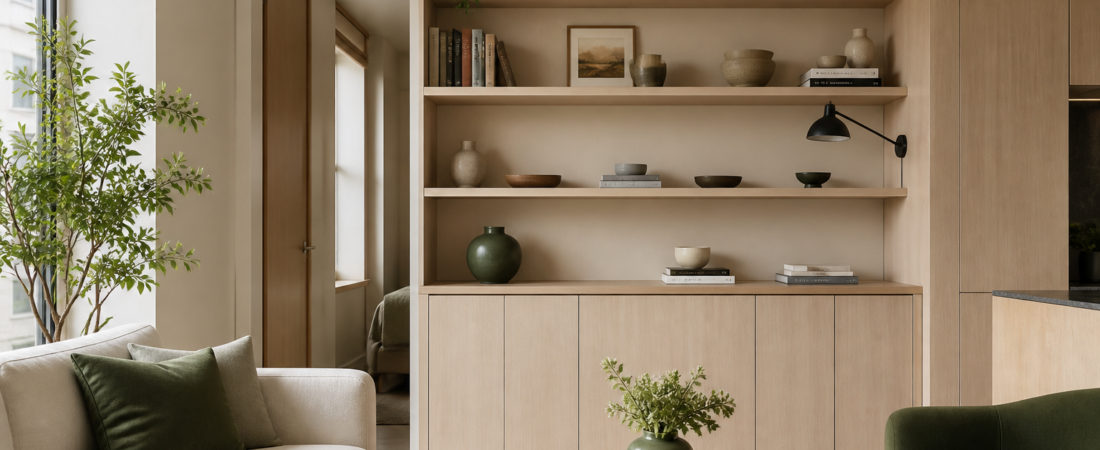
Open shelving can make a small room feel airy and personal. Closed storage can make the same room feel calmer and easier to clean. Neither is universally better. The right choice depends on what you need to store, how visually busy the room already feels, and how much maintenance you want to perform.
Quick comparison: two open and two closed options
| Product | Storage type | Best for | Tradeoff |
|---|---|---|---|
| Furinno Fulda | Open, 3 tiers | Very narrow gaps | Limited display width |
| TUTOTAK | Open, 6 tiers | Vertical display storage | Requires anti-tip attention |
| RiverRidge Ashland | Closed, slim cabinet | Bathroom or laundry clutter | Door swing needs clearance |
| HOSTACK cabinet | Closed cabinet + drawer | Living-area storage | Larger furniture footprint |
The short answer
Use open shelving for attractive, frequently used objects that are easy to return to a consistent place. Use closed storage for visually mixed supplies, backup items, paperwork, cleaning products, and anything you would rather not style.
Most small homes benefit from a combination: approximately one visible layer for personality and one concealed layer for everyday reality.
Advantages of open shelving
- It uses vertical wall space without the visual weight of a full cabinet.
- Frequently used items are visible and easy to reach.
- It can make a narrow kitchen or office feel less enclosed.
- Existing collections, books, and artwork become part of the decor.
- Individual shelves can fit above furniture and in awkward areas.
Open shelves are especially effective when their contents share a limited color palette and vary in height and shape.

Furinno Fulda 3-Tier Narrow Bookcase
Best for: filling a very narrow gap with frequently used items
Advantages: a roughly 10-inch-wide open profile and three accessible tiers.
Consider: small shelves require disciplined editing and lighter objects.
As an Amazon Associate I earn from qualifying purchases. Price, availability, and product details may change.
Disadvantages of open shelving
- Objects collect dust and kitchen grease.
- Mixed packaging creates visual noise.
- Overfilling makes the room feel crowded.
- Items must be returned neatly to preserve the intended look.
- Wall installation and weight limits require care.
Open storage is not maintenance-free storage. It exchanges doors and hinges for more frequent editing and cleaning.

TUTOTAK 6-Tier Narrow Bookshelf
Best for: using vertical space for books or display pieces
Advantages: six tiers in a slim footprint with a storage baffle.
Consider: tall narrow furniture should be stabilized according to instructions.
As an Amazon Associate I earn from qualifying purchases. Price, availability, and product details may change.
Advantages of closed storage
- Doors create a calmer visual field.
- It accommodates mismatched items and practical supplies.
- Contents receive more protection from dust and light.
- Children or pets can be separated from certain objects with suitable locks.
- A cabinet can provide a useful surface above.

RiverRidge Ashland Slim Cabinet
Best for: hiding bathroom or laundry supplies in a narrow zone
Advantages: single door and an interior adjustable shelf.
Consider: allow room for the door to open without blocking circulation.
As an Amazon Associate I earn from qualifying purchases. Price, availability, and product details may change.
Disadvantages of closed storage
- Deep cabinets can hide forgotten items.
- Large pieces may make a small room feel heavy.
- Doors and drawers need clearance to open.
- Interior organization is still necessary.
- Furniture can consume valuable floor area.
Which works better in each room?
Kitchen
Open shelves work for everyday dishes, glasses, and frequently used ingredients in simple containers. Closed cabinets are better for appliances, food packages, cleaning supplies, and less attractive essentials. Near a stove, open shelves require more cleaning.
Living room
Use open shelving for books, a few objects, and framed art. Conceal games, cables, device accessories, toys, and paperwork. A media console with doors plus one open bookcase often feels more balanced than an entire wall of either type.
Bedroom
Closed storage usually creates a more restful environment. One open shelf can display books or personal objects, while clothing and backup linens remain behind doors or inside drawers.
Home office
Open shelves keep reference books and everyday tools accessible. Closed cabinets reduce distractions from files, technology accessories, shipping materials, and supplies. If the office appears on video calls, place the simplest visible storage behind the chair.
Bathroom
Open shelves suit towels and a small number of daily products. Closed storage is preferable for medicine, backups, and visually busy packaging. Consider humidity and choose materials designed for the environment.
How to keep open shelves calm
- Limit each shelf to one or two main categories.
- Leave visible space around objects.
- Use a few boxes or baskets for small items.
- Repeat colors or materials across the arrangement.
- Place heavier objects lower.
- Remove items that are present only to fill space.
How to keep closed storage functional
- Use shallow bins to prevent small objects from disappearing at the back.
- Label categories, even if labels are hidden inside doors.
- Place daily items between waist and eye level.
- Reserve upper shelves for light seasonal goods.
- Review one cabinet at a time every few months.
Consider circulation and door swing
In a narrow room, a closed cabinet may fit physically but still interrupt movement when its doors open. Sliding doors, tambour fronts, shallow drawers, and lift-up panels can reduce clearance needs. Open shelves eliminate door swing but require enough distance to avoid brushing against displayed objects.
Rental considerations
Freestanding shelves avoid permanent changes but should still be anchored when tall or top-heavy. Wall-mounted shelves require hardware suited to the wall and load. Keep installation instructions and original parts so the system can move with you.
Our recommendation
For most compact homes, choose closed storage below eye level and limited open shelving above. This keeps everyday clutter concealed while preserving a sense of height and personality. In rooms where calm matters most, such as bedrooms, lean more heavily toward closed storage. In active work zones, allow more open access.
The best system is not defined by doors. It is defined by whether you can find, use, and return belongings without turning storage into another project.

Recommended product: HOSTACK 31.5-Inch Storage Cabinet
Why it fits: demonstrates when closed storage is useful for reducing visible clutter.
As an Amazon Associate I earn from qualifying purchases. Price, availability, and product details may change.