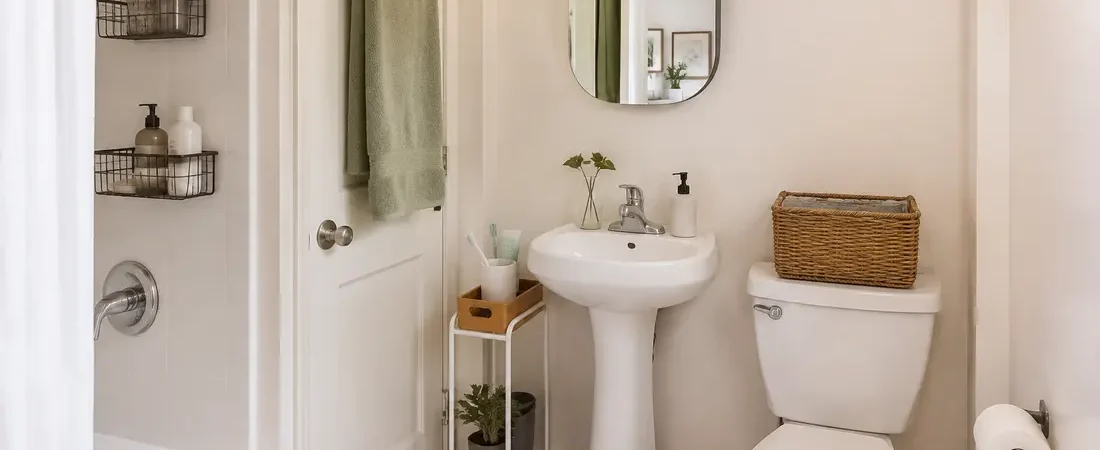
A small bathroom with no vanity, no useful counter, and nowhere obvious to put towels can feel difficult before the day even starts. Toothbrushes gather on the sink rim, shower bottles line the tub, and backup supplies end up in whatever corner remains. Adding more containers does not automatically solve the problem. The room needs a clear division between what you use every day, what can live inside the shower, and what should be stored somewhere else.
This guide provides a complete, renter-friendly plan for bathrooms with pedestal sinks, wall-mounted sinks, shallow cabinets, or almost no built-in storage. You will learn how to measure the room, create practical zones, protect clear walking space, manage moisture, choose organizers carefully, and keep the system working without turning the bathroom into a wall of products.
Quick answer: how do you organize a bathroom with no storage?
Keep only daily essentials beside the sink, move shower products into a suitable caddy, assign towels to the back of the door or another ventilated hanging area, and store unopened backups outside the bathroom. If the room allows it, add one narrow freestanding shelf or cart rather than several unrelated organizers. Choose every item by exact measurements, moisture exposure, and how easily it can be cleaned.
If you have 20 minutes, start here:
- Remove everything that is empty, expired, duplicated, or no longer used.
- Create three groups: daily sink items, shower items, and backstock.
- Return only the daily group to the bathroom. Give the other two groups separate homes before buying anything.
Why a tiny bathroom becomes cluttered so quickly
Most bathrooms without storage have several problems at once. A pedestal sink provides almost no horizontal surface. The door swings into the room. The area near the tub stays damp. Plumbing and baseboards reduce usable floor space. Toiletries also arrive in tall, round, soft, and irregular packages that do not stack well.
The result is predictable:
- daily products occupy the sink and interfere with cleaning;
- backup items mix with open products;
- towels dry slowly because they are layered on one hook;
- small packages disappear behind bottles;
- organizers compete with door clearance and safe movement;
- visual clutter makes the whole room feel smaller.
The goal is not to store the maximum possible amount in the bathroom. It is to keep the right amount accessible, dry, and easy to reset.
Before buying anything: measure the whole route
Measure more than the empty spot where an organizer might stand. Record the narrowest part of the route into the bathroom, the full door swing, the distance from the sink to the toilet, and any baseboard or pipe that changes the available footprint.
For a freestanding shelf or cart, note:
- maximum width, depth, and height;
- baseboard projection at floor level;
- whether the floor is level;
- clearance for drawers, baskets, and doors;
- distance from splashing water;
- space needed to clean around and behind it.
For an over-door product, measure the door thickness and the gap above it. Confirm that the added hardware will not scrape the frame and that baskets or towel bars will not hit a wall, mirror, or person using the room.
15 practical fixes for a small bathroom with no storage or counter
1. Create three storage zones instead of one crowded zone
Divide bathroom items by where they are actually used:
- Sink zone: toothbrush, toothpaste, hand soap, and the few products used every morning or night.
- Shower zone: shampoo, conditioner, body wash, and shower tools.
- Backstock zone: unopened replacements, extra paper goods, guest supplies, and rarely used items.
The backstock zone usually works better outside a very small bathroom. A nearby closet shelf or closed basket can hold replacements until the current product is nearly finished.
2. Give the sink a strict daily-use limit
A pedestal sink rim is not a dependable shelf. If it can hold anything safely, limit it to hand soap and perhaps one toothbrush cup placed away from the edge. Use a small washable tray only when a stable adjacent surface exists. The tray should contain the full daily routine and be easy to lift with one hand for cleaning.
If everything does not fit, move the least frequently used product to a nearby organizer. Do not solve a lack of counter space by balancing bottles where they can fall into the sink or onto the floor.
3. Add one narrow vertical organizer beside the sink
A slim two- or three-tier shelf can turn a narrow strip of floor into useful storage. Keep frequently used products on the upper level, heavier bottles lower, and the floor beneath accessible enough to dry and clean.
A freestanding organizer is best when it does not narrow the walkway or interfere with the door. Look for a stable base, wipeable shelves, and open sides that allow air movement. Decorative plants should not replace space needed for actual bathroom essentials.
4. Use a removable sink skirt only for lightweight storage
A washable sink skirt can visually calm the pipes beneath a pedestal sink and conceal one low, lidded basket. Use a tension or removable system that is appropriate for the fixture and lease. Keep the basket away from plumbing connections and inspect the area regularly for moisture.
Do not hide leaks, electrical devices, medicines, paper goods exposed to dampness, or cleaning chemicals where children or pets could access them.
5. Make the back of the door earn its space
The door can hold one over-door towel bar or a shallow fabric organizer when the door and frame allow it. A towel bar is usually easier to maintain than many small pockets because towels need air around them to dry.
Use pockets only for lightweight, dry items such as unopened cloths, hair accessories, or small paper goods. Avoid heavy glass bottles that swing when the door moves.
6. Use the inside of a cabinet door when you have even one cabinet
A shallow adhesive or hanging holder may store a hairbrush, cleaning cloth, or small tube inside a vanity door. Measure around the sink basin, plumbing, shelves, and door frame before adding anything. The organizer must not prevent the door from closing or press products against pipes.
Follow the holder’s surface instructions and weight limit. Removable does not always mean damage-free on painted, laminated, or humid surfaces.
7. Move shower products off the tub edge
A shower caddy improves drainage and makes the tub edge easier to clean. Depending on the room, choose an over-showerhead caddy, a tension-pole system, or adhesive shelves designed for the exact wall surface.
Adhesive products require careful surface preparation and curing time. They are not suitable for every tile, grout line, textured wall, natural stone, or rental finish. Never place a heavy shelf where failure could cause injury or damage. Keep only the products currently in use inside the shower.
8. Store small shower tools on hooks with drainage
Razors, washcloths, and small brushes dry better when each has a separate hook and does not sit in pooled water. Use hooks made for wet areas and install them only on compatible surfaces. Leave space between items rather than hanging several damp pieces together.
9. Use the toilet area without blocking access
The wall above the toilet can hold shelves or a freestanding over-toilet unit, but it is not automatically safe or practical. Maintain access to the tank, shutoff valve, and any controls. Do not place heavy, breakable, or frequently handled objects above head height.
A lightweight closed basket on the tank may hold a small amount of paper backup if it sits securely and does not interfere with the lid, flushing mechanism, or cleaning. For a full comparison of cabinets, shelves, and freestanding units, see our guide to over-the-toilet storage for small bathrooms.
10. Choose a narrow rolling cart only when it can park safely
A cart can work between a wall and fixture when the gap is wide enough and the wheels stay stable on the bathroom floor. It is useful for daily products on top, folded cloths in the middle, and heavier bottles below.
Do not park a cart where it blocks the toilet, door, heating vent, or access to plumbing. Locking wheels help only if they are easy to reach. A cart that must be moved every time someone uses the room will rarely stay organized.
11. Store backups outside the bathroom
Unopened shampoo, extra toothpaste, bulk paper goods, and guest supplies do not need prime bathroom space. Place them in one labeled basket in a nearby closet, bedroom cabinet, or laundry area that remains dry.
Give backstock a fixed capacity. When the basket is full, use what you own before buying more. This prevents sale purchases from becoming a storage problem.
12. Decant only products that benefit from it
Matching pumps can reduce visual noise, but transferring every product creates extra cleaning and makes identification more difficult. Decant only a frequently used product when the new container is compatible, easy to wash, and clearly identifiable.
Keep original instructions, warnings, ingredients, expiration information, and product identification available. Never transfer medicine, chemicals, or products that could be confused with something else.
13. Give each towel enough air to dry
One hook may save wall space, but a folded wet towel dries slowly. Use a bar, spaced hooks, or an over-door rack that allows each towel to hang without touching the floor or toilet. Keep clean towels in a dry area rather than storing a large stack in a humid room.
For shared bathrooms, assign one position per person. A consistent location reduces confusion and stops towels from migrating to door handles.
14. Reduce visual clutter with one closed container
Open shelves are convenient, but dozens of labels can make a small room feel busy. Use one wipeable, ventilated basket or box for less attractive daily items. Keep frequently used products visible enough that you do not forget them.
If you are deciding between display and concealment, our guide to open shelving versus closed storage explains the tradeoffs.
15. Reset the room for five minutes each week
Return products to their zones, remove empty packages, wash the daily tray, wipe the organizer shelves, and move a replacement from backstock only when needed. Inspect adhesive storage and freestanding furniture for movement, moisture, or damage.
This small routine is more effective than adding another container. You can connect it to our weekly reset routine for a small home.
Realistic layouts for common small bathrooms
Pedestal sink with a swinging door
- Keep soap and one toothbrush cup at the sink.
- Place a narrow freestanding organizer on the side outside the door swing.
- Use an over-door towel bar only if the towel clears the floor and fixtures.
- Move all unopened products to a nearby closet.
Wall-mounted sink with no floor clearance
- Keep the floor beneath the sink mostly open for cleaning.
- Use one narrow wall-adjacent cart rather than filling the plumbing area.
- Store daily toiletries in a portable caddy that can leave the bathroom.
- Use the shower zone and back of the door for items used there.
Tiny bathroom shared by several people
- Give each person one portable caddy or one clearly defined shelf section.
- Keep only shared soap and hand-drying supplies at the sink.
- Assign separate towel positions with enough drying space.
- Keep personal backstock and rarely used items outside the room.
Rental bathroom with one shallow medicine cabinet
- Reserve the easiest shelf for lightweight daily items.
- Use shallow trays so small tubes do not disappear at the back.
- Do not overload glass shelves or store items that interfere with the door.
- Follow safe storage instructions for any medicine rather than assuming the humid bathroom is suitable.
Where each bathroom category should live
Daily dental care
Keep toothbrushes where they can air-dry without touching each other or the toilet area. Store toothpaste with them and move spare tubes to backstock. Choose a holder that is easy to wash around the base.
Skin and hair products
Keep only the products used most days in the accessible zone. Place occasional products in one contained bin outside the room or on a lower-frequency shelf. Tall bottles should not be stored above eye level where they are difficult to lift safely.
Toilet paper
Keep one or two replacement rolls within reach in a dry, stable holder. Store the bulk package elsewhere. Avoid placing paper directly on the floor or beside a frequently wet tub.
Cleaning supplies
Keep bathroom cleaners together, upright, in their original containers, and according to label directions. Store them separately from toiletries and out of reach of children or pets where applicable. A very small bathroom may not be the right place for the full cleaning supply collection.
Medicines and first-aid items
Follow the storage instructions on each product. Heat and humidity can make the bathroom unsuitable for many medicines. Keep them secure, clearly identified, and inaccessible to children where required.
Optional organizers worth considering
This section contains affiliate links. You do not need all of these products. Choose only an organizer that solves a measured problem and suits your surfaces, door clearance, and rental agreement. Our recommendations are based on published dimensions, materials, access, adjustability, and suitability for compact homes. We have not physically tested every item mentioned, so confirm current specifications before ordering.
Best for a narrow dry area: LEMIKKLE two-tier countertop organizer
The published dimensions are approximately 12.2 inches wide, 7 inches deep, and 13.4 inches high. The two levels can organize a small group of toiletries on a stable dry surface or shelf. In a bathroom with almost no counter, it may also work on a secure freestanding unit.
Measure first: the full 7-inch depth, bottle height on both levels, and clearance around the sink. Do not place it where splashing or a narrow walkway makes it unstable.
View the LEMIKKLE two-tier organizer on Amazon
Best for moving a hand towel off the sink: KES over-door towel bars
These stainless-steel bars hang over a compatible cabinet or door without drilling. They can help when the bathroom has a vanity door but no convenient towel space. The product is sold as a two-pack, so confirm that you actually need both pieces.
Measure first: door thickness, space above the door, handle clearance, and the distance needed for the door to close without rubbing.
View the KES over-door towel bars on Amazon
Best for moving bottles off the tub edge: Kitsure adhesive shower caddies
This two-pack uses adhesive mounting and is designed for wet-area bathroom storage. The open-wire shelves support drainage and can separate currently used shower products from the sink zone.
Check first: wall material, grout placement, installation and curing instructions, weight limit, removal method, and lease terms. Adhesive storage is not suitable for every surface, and a successful installation depends on following the manufacturer’s directions.
View the Kitsure shower caddies on Amazon
As an Amazon Associate I earn from qualifying purchases. Product availability, specifications, and seller details may change. Check the current listing before buying.
What is usually not worth buying for a tiny bathroom
- A wide floor cabinet that narrows the route. Storage is not useful if the door or fixture becomes harder to use.
- Large sets of matching containers before measuring. Many pieces will not fit the room or your actual routine.
- Heavy glass containers above the toilet or sink. Choose safer locations and lighter materials.
- Deep opaque bins for daily items. They make small products difficult to see and encourage duplicates.
- Adhesive shelves marketed as universal. Surface compatibility, preparation, moisture, load, and removal all matter.
- Decorative ladders that do not let towels dry. Check spacing, stability, and floor footprint before using one.
- Bulk packages stored in the bathroom. They consume scarce space and may be exposed to humidity.
For additional ideas that work beyond the bathroom, see our small-apartment storage guide.
Moisture, safety, and renter considerations
- Keep ventilation grilles, heaters, outlets, plumbing access, and the toilet shutoff valve unobstructed.
- Do not store electrical tools or chargers where they may be exposed to water.
- Allow towels and shower tools to dry fully rather than layering damp items.
- Use organizers made for humid environments and clean them according to their instructions.
- Check adhesive products and freestanding furniture regularly for loosening, rust, swelling, or instability.
- Confirm wall mounting, drilling, adhesive use, and repair responsibilities in your lease before installation.
- Keep medicines, chemicals, and sharp objects stored according to their labels and household safety needs.
Frequently asked questions
Where should I put toiletries if I have a pedestal sink?
Keep only a few daily items at the sink and use a narrow freestanding organizer beside it if the walkway allows. A portable caddy stored outside the room is another useful option when there is no safe floor space.
Can I put a cabinet under a pedestal sink?
Only a cabinet designed around the pedestal and plumbing may fit, and it still needs ventilation, cleaning access, and room for connections. Measure carefully and avoid pressing furniture against pipes. A simple low basket or separate narrow shelf is often more flexible for renters.
How do I organize a bathroom without drilling?
Use stable freestanding shelves, suitable over-door products, tension systems, portable caddies, and adhesive organizers only on compatible surfaces. No-drill does not automatically mean damage-free, so follow product instructions and lease terms.
Can I use adhesive shelves on bathroom tile?
Only when the manufacturer lists the specific surface as compatible. Avoid placing adhesive over grout or textured areas unless instructed. Prepare the surface, observe curing time, respect the weight limit, and check the shelf regularly.
Where should extra toilet paper go?
Keep one or two replacement rolls in a dry holder within reach. Store bulk packages in a nearby closet or other dry area rather than filling the bathroom.
How can I keep a bathroom counter clear?
Limit the sink zone to daily essentials, use one small washable tray, and move occasional products to a separate bin. The tray’s physical size becomes the capacity limit.
Is a rolling cart good for a small bathroom?
It can be, if it parks outside the walkway, remains stable on the flooring, and does not block a fixture or plumbing. Measure the entire route and include baseboards and wheel width.
How should several people share a tiny bathroom?
Keep shared soap at the sink and give each person one portable caddy or defined shelf section. Assign separate towel positions and keep personal backups outside the room.
Should towels be stored above the toilet?
Clean towels are better stored in a dry, protected location. If the toilet wall is the only option, use secure closed storage with safe clearance and avoid keeping a large stack in a humid room.
How do I make open bathroom storage look calmer?
Keep broad categories, repeat one or two container materials, remove empty packaging, and use one closed basket for visually busy items. Leave some empty space so products remain easy to reach and clean around.
What should not be stored in a humid bathroom?
Follow individual storage instructions. Many medicines, paper backups, electronics, and moisture-sensitive products are better kept elsewhere. Keep household chemicals in their original containers and separate from toiletries.
Can I organize the bathroom without buying anything?
Yes. Remove unused products, separate daily items from backups, relocate extras, reuse one washable tray, assign towel positions, and schedule a weekly reset. Buy an organizer only after the remaining problem has a specific measurement and purpose.
Your small-bathroom checklist
- Remove empty, expired, duplicated, and unused products.
- Create sink, shower, and backstock zones.
- Keep only daily essentials beside the sink.
- Move unopened replacements outside the bathroom.
- Measure the door swing, baseboards, pipes, and walkway.
- Choose one main organizer instead of several small fixes.
- Give each towel enough space to dry.
- Keep products off wet tub and shower edges.
- Protect ventilation and plumbing access.
- Reset and inspect the room every week.
The bottom line
A bathroom without cabinets or counter space can still work well when each item earns its place. Keep the sink zone small, move shower products to a draining caddy, hang towels where they can dry, and store backups somewhere less valuable. Add one measured organizer only after you know exactly what it needs to hold.
The most successful small-bathroom system is not the one with the most shelves. It is the one that leaves the sink usable, the walkway clear, the room easy to clean, and the daily routine simple to repeat.